

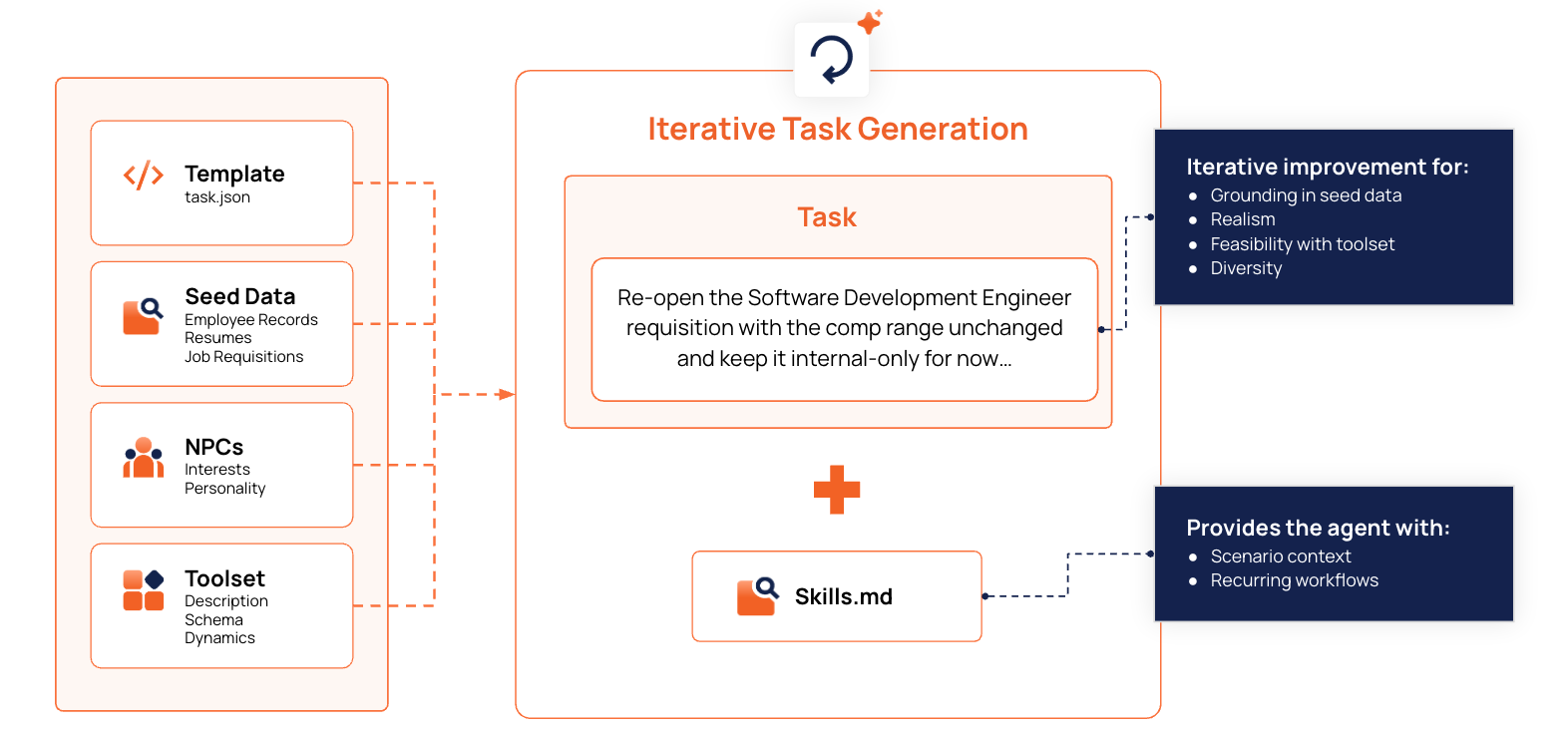
Inputs
- Template (
task.json) — The structural blueprint that defines the task format and constraints. - Seed Data — Domain-specific records injected into the playground (e.g., employee records, resumes, job requisitions).
- NPCs — Simulated users with defined interests and personality traits that interact with or are referenced by the task.
- Toolset — The available tools described by their descriptions, schemas, and dynamics.
Iterative Task Generation
The generator combines these inputs and iteratively improves the output for:- Grounding in seed data — Tasks reference real data present in the playground.
- Realism — Instructions reflect plausible real-world scenarios.
- Feasibility with toolset — Tasks are solvable using the available tools.
- Diversity — Generated tasks cover a range of scenarios and difficulty levels.
Skills.md
Each task is paired with aSkills.md file that provides the agent with:
- Scenario context — Background information about the task domain and situation.
- Recurring workflows — Common patterns and procedures the agent should follow.
Task Bundle Output
A generated task bundle contains:- Task metadata — Unique ID, display name, difficulty, and category.
- Task instruction — The natural language instruction given to the agent.
- Tool servers — Which tool servers are required.
- Seed data — Data injected into the playground before the agent starts.
- Verifiers — Automated checks that determine whether the agent succeeded.